PARTS
A skateboard consists of 7
parts: Deck, Grip, Trucks, Wheels, Bearings, Risers, and Hardware.
Deck:
The wooden part of the board that you stand on.
(more info)
Grip
Tape: Traction tape that goes on the topside of the deck.
(more info)
Trucks:
Attaches under deck, has axles for wheels, controls turning.
(more info)
Wheels:
The “tires” for the board.
(more info)
Bearings: Goes inside of wheels, effects speed.
(more info)
Hardware: The nuts and bolts that hold the trucks to the deck.
(more info)
Risers:
(optional) goes between deck and trucks. Cushions ride, Creates larger gap
between wheels and deck. (more
info)
DECKS
The deck is probably the
part of the skateboard that receives the most attention, and will be the part of
the skateboard being replaced the most.
A Skateboard deck is a
combination of thin sheets of wood(plys) pressed together with glue in between
the layers to hold it all together. The better decks have all plys being
Canadian Maple, usually 7plys.
DECK TYPE:
Skateboarding has changed
over time, and decks have changed with it.
OLD SCHOOL: What you would
have seen in the 80’s. Square tail, pointed nose, larger width.
LONGBOARD: Usually 40” + in
length designed for cruising, and downhill.
NEW SCHOOL: What kids are
currently riding. Nose and Tail Kick, and Concave. Designed for tricks.
For the rest of this
guide, we will only be referring to new school decks.
BRANDS, BLANKS, PRO
DECKS.
I’ve divided the next part
of this into two parts: PRO DECKS, and BLANK DECKS.
PRO DECK: A brand name
deck, one you would see in a core skate shop. This will have a graphic on the
bottom. On the market today there are hundreds of brands of decks. This is can
be really confusing; when they all claim they’re better then the brand sitting
next to them. Ask 10 kids, they’ll all give you a different opinion about whose
is better. THE TRUTH: There are about 6 factories in the world that produce 90%
of all the skateboard decks in existence. Most pro decks are equal; the
difference is the picture on the bottom. Some expectations apply with different
deck constructions like Element’s Fiberlight and Helium series of decks.
BLANK DECK: "Blank Deck"
refers to absence of a graphic on the bottom. These can be sometimes just as
good as a pro deck, and some cases could be far inferior. Since this is my
guide, I will insure you the Blanks that we sell are equal to a pro deck, and
are made in the same factory that produces many of the top selling brands.
DECK SIZE
Decks will vary in width
from 6 ½” – 8 ½”, and length from 26” – 32”. This is probably the part where a
new skateboarder parent has the most confusion. I’m going to divide this in 3
categories: Mini, Normal, and Large.
Mini:
Deck Length under 30” and Widths 6 ½” – 7 3/8”. The length is the major
indicator to being a mini or not.
Normal:
Deck Width 7 3/8” – 8”, and Deck lengths 31” – 31.75”
Large:
Deck Widths over 8”, and Lengths longer then 31.75”
What size should I, or
my Kid Use?
This is often made a lot
more confusing then necessary, and everyone has an opinion.
If the rider is under 8, I
would recommend a mini.
Everyone else I would
recommend a normal size deck.
Bottom line for parents
of a new skater: Buying your kid a
normal size deck won’t hurt them; it will make it easier to ride around the
neighborhood because of the increased stability from the larger foot room. Where
it could become a problem is when they try and do tricks. If you’re really in
doubt to what size to buy, go with the normal sized board. I tell most people it
doesn’t really matter on their first board; people will decide what size works
best for them after riding a few over time. If they already have a board, break
out the tape measure, or just ask them. Nothing regarding a rider’s size and
board size is set in stone.
Remember decks are made of
wood and can and will break. The more advance tricks will lead to more broken
decks. Decks could last years; others may snap one in hours.
Return To
Top
GRIP
TAPE
Grip tape goes on the top
side of the deck and is used for traction. There’s a few brands of grip tape on
the market, some vary slightly. We normally use Black Diamond on most of our
completes because it’s a great value, and the perfect mix of thickness and grit.
Jessup, and Black Magic are other very popular brand names of grip tape. 99%
customers choose black, but it’s available in a rainbow colors, and some
graphic.
Return To
Top
TRUCKS
Trucks are second most
expensive component. Trucks vary in styles, widths, weight, brands, and colors.
Width:
This can also be confusing, and for a good reason it’s different per company.
The axle width on a standard full size truck is 7 ½” – 7 ¾”. The standard truck
size will be referred to by the measurement of the hanger not including the
axle.
For Example a 5.0 Truck, is
5” hanger, with a 7 ½ - 7 ¾” axle, this is what is considered the standard. Some
companies such as Independent do it in metric, their standard is a 129. Just to
be confusing Krux does it 3.5 being their standard. To summarize: 5.0, 129, 3.5
are all the same size, and that is the current standard.
Smaller sizes, such as
minis will be less, such a 4.75, or 3.0. Larger used for longboarding and wider
decks sizes will be a 6.0, 149, or 4.5.
Below is a basic chart of
the some of the more popular brands and sizes.
|
Core |
4.75 |
7 1/2” |
Royal |
5.0 |
7 5/8” |
|
Core |
5.0 |
7 5/8” |
Randal |
150 |
8 5/8” |
|
Core |
6.0 |
8 5/8” |
Randal |
180 |
9 5/8” |
|
Core |
7.0 |
9 5/8” |
Silver |
5.0 |
7 1/2” |
|
Destructo |
5.0 |
7 5/8” |
Tensor |
5.0 |
7 5/8” |
|
Grind King |
5.0 |
7 5/8” |
Thunder |
145 |
7 5/8” |
|
Independent |
129 |
7 5/8” |
Titan |
127 |
7 1/2” |
|
Independent |
149 |
8 1/2” |
Tracker |
129 |
7 5/8” |
|
Independent |
215 |
10” |
Venture |
5.0 |
7 5/8” |
|
Krux |
3.5 |
7 5/8” |
Venture |
5.25 |
8” |
Brands:
You’ll see many brands of trucks on the market.
While most are very similar some vary slightly, I would research them a little
bit if your concern.
Bushings:
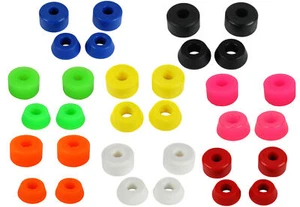
These are the urethane cushions in the truck
that control the resistance of turning. Most stock bushing on trucks is around
a medium hardness (95A), which should accommodate most. Bushings are available
after market in many different colors and hardness’s. A softer bushing makes it
easier to turn leaving very little resistance (aka loose), and a harder bushing
makes it to turn (aka tight). The rider’s weight does influence the amount of
resistance, smaller kids will have trouble turning on harder bushings, and
larger riders will damage soft bushings. The stock bushings on trucks may need
to replaced with softer ones for small riders.
Return To
Top
WHEELS
These are the “tires” of
the board. Wheels besides varying in cosmetic things such as color, and graphic
they vary in size and determine(hardness).
SIZE:
Wheels vary in heigth from
46mm to over 70mm. Size is varys depending on the type of skating your doing.
Like most things in skating everyone has an opinon this guide is just a guide to
help point you in the right direction.
46 - 50mm – Super small,
used in a indoor park setting. Used by more experienced skater.
50 – 54mm – The popular
size range today. Park only use 50 – 52mm, outdoor skater use 52 – 54mm because
it’ll get caught in less cracks, and imperfections in the concrete.
56 – 60mm – Larger sized
wheel, old school, cruising boards, and half pipe riders.
60mm+ - Usually for
longboards, should be softer. Designed for cruising not tricks.
DUROMETER:
This is the hardness of the
wheel. Lower the number softer the wheel.
Outdoor skating should be
around a 97A – 101A
Longboarders/Cruisers
should ride a 78A – 82A wheel.
Return To
Top
BEARINGS
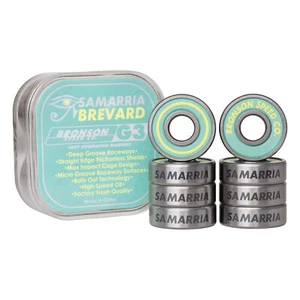
Bearings go inside of the
wheel and effects the speed. Bearings vary in cost from $5 a set to over $100
per set. The price has to do with what’s going on in the inside of the bearing.
Don’t be fooled by colored shields, and pretty packaging.
While bearing information
can get very technical, only some of it actually matters to skateboarding, and
even less matters to you as a consumer, since companies don’t put everything on
their packaging.
We will now discuss: ABEC
Rating, Shields, Balls, Retainers, and Lubrication.
ABEC RATING:
The ABEC scale is a system
for rating the manufacturing tolerances of precision bearings. The system was
developed by the Annular Bearing Engineering Committee (ABEC). You will see ABEC
3, 5, 7, 9 and some even higher in the market place. Skate companies use ABEC to
classify their bearings, but not as the true definition as above. Tolerance
isn’t in the equation to making a good bearing for skating. Speed is the number
one concern for skaters when buying bearings, companies use ABEC as a grading
scale of their product. Un-fortunately one companies ABEC 3, doesn’t mean it’s
equal to another’s ABEC 3. The raceways, finish on the balls, ball retainers,
and quality/weight of the lubricant matter when it comes to speed.
Some companies such as
Bones do not list an ABEC rating on their bearing, and use a different way to
list their product levels.
SHIELDS:
Two types of shields are
used on bearings: Steel, and Rubber. Steel shields can be either removable
(serviceable) or non-removable (staked, non-serviceable). This means if you are
able to remove the shields in order to clean the bearings. Better bearings are
serviceable. Rubber shields remove easily, and are becoming the most popular
amongst skaters.
BALLS:
Balls are normally made of
steel, and have hardness’s which is on the Rockwell scale. Since no company
lists the exact hardness of their balls, no sense on writing much about it. A
cheaper bearing with soft metal used, will flat spot over time with impact and
begin wearing away the inside of the bearing causing to be noisy and slow.
Ceramics Balls are on the
market, and are harder then steel balls. Plus they don’t rust, but these can be
very expensive, and not for average skater.
Most bearings have only 7
Balls, this places all impact and side load on only 1-2balls. Some bearings use
8 Balls to spread out the load, and create a longer lasting and stronger
bearing.
RETAINER:
This is the piece inside of
the bearing that holds the balls. Better bearings will use a Delrin Crown, or
something that self-lubricates the bearing over time. Cheaper bearings use a
metal retainer, or nylon which begins wearing the balls over time, and
eventually ruining the bearing.
LUBRICATION:
Grease and Oil are types of
lubrication used. Most skaters use oil because it allows the bearing spin good
right away. A greased bearing will be slow at first until the grease begins to
break down, and “channel” into bearing making it faster and a longer lasting
lubricant in the end. Oiled bearings should be re-oiled after every couple of
weeks of use. Make sure you use a light synthetic oil.
Return To
Top
HARDWARE:
These are the nuts and
bolts that holds the trucks to the deck. These are available in a bunch of
colors.
SIZE:
7/8” – No Riser Pad
1” – 1/8” Riser. (MOST
POPULAR)
Most hardware is available
in both Phillips and Allen head, the choice is yours.
Return To
Top
RISERS:
Risers are good for two things: avoiding
‘wheel bite’ and shock absorption.
Wheel bite (burn) is when the wheels rub the
bottom of the deck. This happens a lot with hard landings or turns. Risers
provide a little more distance between the board and the wheel preventing bite.
Risers come in a variety of thicknesses and
hardnesses. Softer and thicker risers absorb more shock than thin, hard risers.
Downhillers and cruisers often select thick risers to make sure their larger
wheels have adequate distance from the deck. This gives them more freedom for
turning and a much smoother ride. Thinner risers are often chosen by those who
skate street, ramp, and park. While absorbing shock, risers also help to keep
hardware from vibrating loose on rougher surfaces.
Risers aren’t required, but
strongly suggested.
Return To
Top |